
PRP Hair Restoration: What to Expect From a Physician-Led Treatment Plan
Considering PRP for thinning hair? Learn how PRP hair restoration works, what treatment planning involves, and why a physician assessment matters.
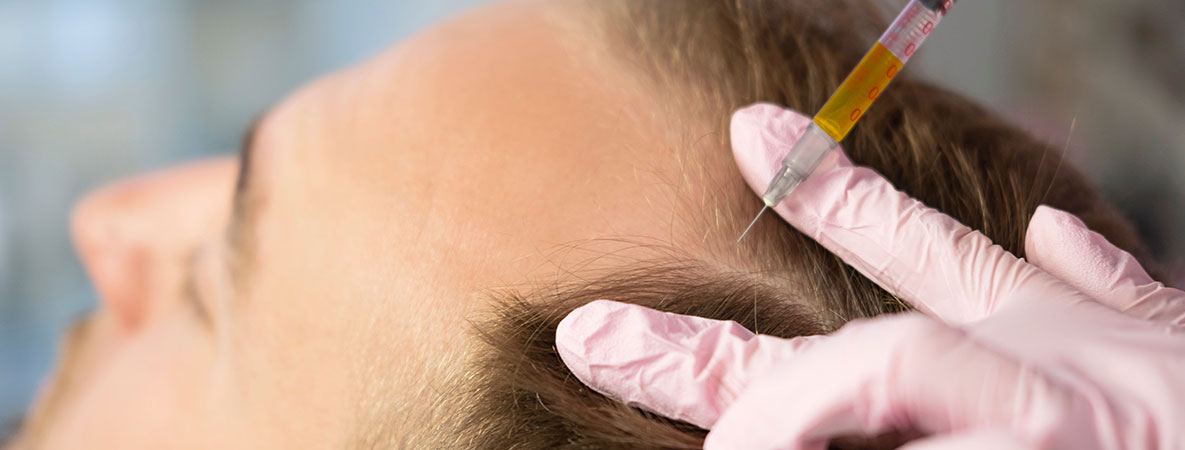
Hair thinning can be frustrating, particularly when it is difficult to understand why it is happening or which treatment is actually appropriate.
PRP, or platelet-rich plasma, has become one option patients may encounter when researching non-surgical approaches to hair restoration. But PRP is not simply a procedure that should be performed whenever someone notices less hair.
At MD Glow Lab in Toronto, Dr. Keith Wong approaches PRP hair restoration by first assessing the individual concern, pattern of thinning and treatment goals. The question is not simply whether PRP can be performed, but whether it makes sense as part of your particular treatment plan.
What is PRP hair restoration?
PRP stands for platelet-rich plasma.
Treatment begins with a sample of your own blood. That sample is processed to separate and concentrate the platelet-rich portion, which contains naturally occurring growth factors involved in the body’s healing and tissue-repair processes.
The prepared PRP is then used to treat selected areas of the scalp.
In hair restoration, the goal is to support the environment around existing hair follicles and potentially improve the appearance of thinning hair over time.
PRP does not create entirely new hair follicles, and it should not be presented as a guaranteed solution for every form of hair loss.
That distinction is important when setting realistic expectations.
Why does the cause and pattern of hair thinning matter?
“Hair loss” is a broad description rather than a single diagnosis.
People can notice changes such as:
- Gradual thinning
- A widening part
- Reduced density in particular areas
- Changes around the hairline
- Increased shedding
- A combination of shedding and progressive thinning
Those concerns do not necessarily have the same underlying explanation.
That is one reason an assessment matters before deciding on a treatment.
PRP works with existing hair follicles. If someone is experiencing hair loss for reasons that require a different medical approach, simply performing PRP without understanding the broader picture may not address the underlying concern.
At MD Glow Lab, Dr. Wong considers the pattern of hair thinning and relevant individual factors before discussing whether PRP may have a role.
How does PRP work for hair restoration?
Platelets are best known for their role in blood clotting, but they also contain signalling proteins and growth factors involved in normal healing processes.
PRP treatment concentrates platelets from the patient’s own blood and introduces that platelet-rich plasma into targeted areas of the scalp.
Research into PRP for hair restoration has explored its potential effects on the hair-follicle environment and hair-growth cycle. Clinical responses vary, and PRP protocols are not identical across every practice or study.
For patients, the important takeaway is simpler:
PRP is intended to support existing follicles. It is not an instant replacement for lost hair.
That is why patient selection and realistic expectations are central to treatment planning.
Who might want to discuss PRP hair restoration?
Someone noticing progressive thinning or reduced hair density may want to discuss PRP as one potential option.
That does not mean everyone concerned about their hair is automatically a candidate.
During a consultation, Dr. Wong can consider factors such as:
- The pattern and extent of thinning
- How long the changes have been occurring
- Whether shedding is also present
- Previous hair-restoration treatments
- Relevant health history
- Current medications or treatments
- Your expectations and goals
Depending on what is identified, PRP may be considered, or further assessment may be appropriate before proceeding.
What happens during PRP hair treatment?
The basic PRP process involves three stages.
1. Blood collection
A small sample of your blood is collected.
2. PRP preparation
The blood is processed to separate and concentrate the platelet-rich plasma from other components.
3. Scalp treatment
The prepared PRP is administered to selected areas of the scalp according to the treatment plan.
The exact treatment protocol can vary according to the patient and clinical approach. Dr. Wong and his team will explain the process, aftercare and expectations associated with your individual treatment.
Is one PRP treatment enough?
Hair restoration should generally be thought of as a process rather than an immediate event.
Hair itself grows through cycles, and visible changes in density or quality do not happen overnight.
PRP treatment plans may therefore involve more than one appointment, depending on the individual patient and treatment strategy.
Rather than focusing on a universal number of sessions, Dr. Wong can recommend a plan based on your presentation and evaluate your response as treatment progresses.
This also helps avoid a common misconception: more treatment does not automatically mean better treatment.
The appropriate schedule should have a clinical rationale.
When should I expect to see a difference?
Hair growth is slow.
Even when treatment is having a biological effect, visible changes take time because the hair must progress through its normal growth cycle before differences become apparent.
For that reason, PRP hair restoration should not be judged in the same way as a treatment that produces an immediate cosmetic change.
Response also varies between patients.
Some people may notice changes in shedding, density or hair quality over time, while others may have a more limited response. No responsible treatment plan should guarantee a specific amount of regrowth.
Progress is better assessed over time using consistent observations rather than checking the mirror every few days.
Does PRP regrow a completely bald area?
This is an important expectation to clarify.
PRP is intended to work with existing hair follicles. It does not create new follicles where they no longer exist.
That means the characteristics of the treatment area matter.
An area with thinning, miniaturized hairs is not necessarily the same treatment situation as an area where hair follicles are no longer functioning.
This is another reason why an assessment should come before the procedure.
PRP versus a hair transplant
PRP and hair transplantation are fundamentally different approaches.
A hair transplant surgically relocates hair follicles from one area to another.
PRP does not relocate follicles. It is a non-surgical regenerative treatment intended to support existing follicles in the areas being treated.
They should therefore not be viewed as interchangeable procedures.
For some people, non-surgical treatment may be worth discussing. For others, the degree or pattern of hair loss may lead to a different conversation.
Can PRP be combined with other hair-restoration treatments?
Hair restoration does not necessarily need to rely on one intervention.
Depending on the cause and pattern of hair thinning, different approaches may address different aspects of the concern. At MD Glow Lab, Dr. Wong may discuss PRP alongside other regenerative options, including exosome-based scalp treatment, as part of a personalized hair-restoration plan.
One option available at MD Glow Lab is ASCEplus HRLV, a professional exosome-based formulation developed specifically for scalp and hair care.
PRP and exosome-based scalp treatment are not the same thing. PRP is prepared from your own blood and uses concentrated platelets and their naturally occurring growth factors. ASCEplus HRLV is a professionally formulated exosome-based scalp product.
Depending on your individual assessment and goals, Dr. Wong can discuss whether PRP, exosome-based scalp treatment, or a broader treatment strategy may be appropriate.
Other medically managed approaches may also be relevant depending on the cause of hair loss. The objective is not to add treatments simply because they are available, but to develop a plan that makes sense for what is happening with your hair.
Why consistent photographs matter
Hair restoration can be surprisingly difficult to judge casually.
Hair length, styling, lighting, whether the hair is wet or dry, camera angle and even where the hair is parted can make density look different from one photograph to another.
Consistent clinical photography can therefore be useful when assessing changes over time.
When comparing progress, photographs are most useful when they are taken under similar conditions rather than selecting dramatically different lighting or hairstyles.
This helps create a more realistic picture of whether meaningful change has occurred.
What happens after PRP hair restoration?
Some temporary changes in the treated scalp can occur following PRP.
Dr. Wong and his team will provide aftercare instructions based on the treatment performed and explain what to expect following your appointment.
If something after treatment concerns you or differs from what was discussed, contact the clinic rather than relying on generalized instructions found online.
Individual recovery experiences can vary.
What questions should I ask before PRP hair restoration?
A useful consultation should involve more than asking how much the procedure costs.
Consider asking:
- What pattern of hair thinning do you see?
- Is PRP appropriate for what is happening with my hair?
- What is PRP intended to accomplish in my case?
- What would be a realistic result?
- How will we evaluate whether I am responding?
- Could another issue be contributing to my hair changes?
- Would PRP or an exosome-based scalp treatment such as ASCEplus HRLV make more sense for my concerns?
- Are there other treatment options I should consider?
- What happens if I do not respond as expected?
Those questions help establish whether there is an actual treatment strategy behind the procedure.
Is PRP hair restoration right for me?
There is no universal answer.
PRP may be worth considering for some patients experiencing hair thinning, but the appropriate treatment depends on what is happening with your hair, your individual circumstances and your goals.
The starting point should therefore be an assessment rather than deciding in advance that you need PRP.
At MD Glow Lab, Dr. Wong can evaluate your concerns, discuss what PRP is designed to do and determine whether PRP, an exosome-based scalp treatment such as ASCEplus HRLV, or another approach may have a role in your treatment plan.
Learn more about PRP Hair Restoration at MD Glow Lab or explore our regenerative treatments to learn more about PRP, exosome-based treatments and other physician-led regenerative options available at MD Glow Lab in Toronto.
Begin Your Glow Journey
Experience the art of science-driven beauty - refining your glow and elevating your confidence through natural results by Dr Keith Wong.
Have a question about which treatment is right for you? Send us an inquiry, or book your appointment online when you are ready.
