
GLP-1 Medical Weight Management and Loose Skin: Planning for Changes in the Face and Body
Learn how significant weight loss can affect facial volume and skin laxity, and how treatments such as QuantumRF, Morpheus8, Forma, and dermal fillers may fit into a personalized plan.
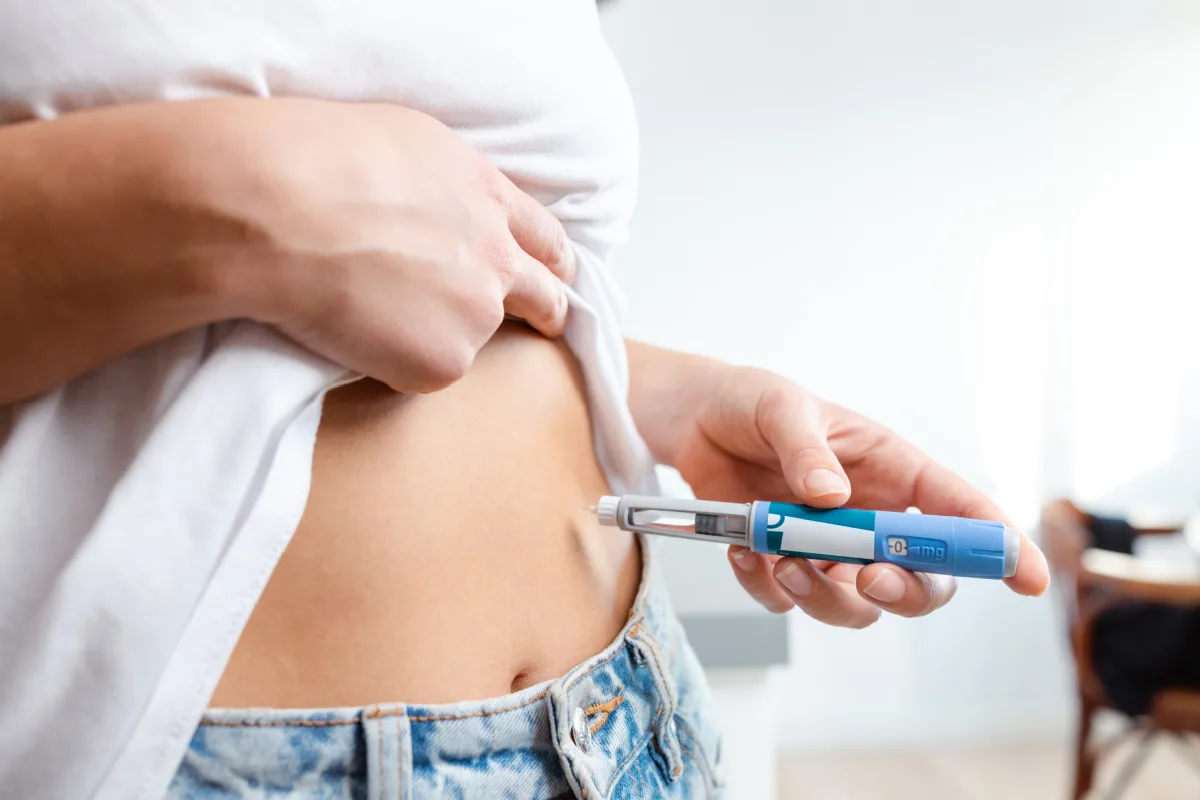
Losing a meaningful amount of weight can have significant health and personal benefits. It can also change the face and body in ways that patients may not have anticipated.
As fat volume decreases, some people notice facial hollowing, changes in facial contours, or looser skin in areas of the face and body. These changes have received particular attention as GLP-1 medications have become more widely used for medical weight management.
You may have heard the term “Ozempic face.” Despite the name, the changes being described are not unique to Ozempic. Significant weight loss itself can affect facial volume, skin laxity, and body contours regardless of how that weight loss was achieved.
At MD Glow Lab in Toronto, Dr. Keith Wong can look at both sides of this journey. Medical weight management is approached as a physician-led medical service, while changes in facial volume, skin quality, or laxity can be assessed separately. Depending on what has changed, treatments such as Forma, Morpheus8, QuantumRF, or dermal fillers may be considered as part of a personalized aesthetic plan.
Why can the face look different after weight loss?
Fat is part of the structure of the face.
It contributes to facial contours and provides volume beneath the skin. When a person loses a meaningful amount of weight, facial fat can decrease along with fat elsewhere in the body.
Depending on the individual, this can make certain changes more noticeable, including:
- Hollowing through the cheeks or temples
- Changes beneath the eyes
- More visible facial folds
- Reduced facial fullness
- Changes along the jawline
- Increased appearance of skin laxity
- Changes in overall facial proportions
Age, baseline facial anatomy, skin quality, the amount of weight lost, and other individual factors can all influence how noticeable these changes become.
Two people can therefore lose a similar amount of weight and experience very different changes in their faces.
What does “Ozempic face” actually mean?
“Ozempic face” is a popular term rather than a medical diagnosis.
It is commonly used to describe facial hollowing, volume loss, skin laxity, or a more aged appearance noticed after significant weight loss associated with medications such as Ozempic.
The terminology can be misleading.
Ozempic is one brand of semaglutide, which acts on the GLP-1 receptor. More importantly, facial volume changes are not exclusive to one medication or even to medication-assisted weight loss.
Significant weight reduction itself can change facial fat and the relationship between the skin and the structures underneath it.
Rather than treating “Ozempic face” as a single condition with a single solution, Dr. Wong looks at what has actually changed.
Is the concern primarily lost facial volume? Skin laxity? Changes in skin quality? Or a combination?
That distinction helps determine which treatment options may make sense.
Does GLP-1 treatment cause loose skin?
People undergoing significant weight loss can experience skin laxity as the volume beneath the skin decreases.
It would be overly simplistic, however, to attribute every change directly to the medication itself.
Factors such as:
- The amount of weight lost
- How quickly weight changes
- Age
- Baseline skin elasticity
- Genetics
- Previous weight fluctuations
- Existing skin quality
- The area of the face or body
can all influence how the skin responds.
For patients using GLP-1 medications as part of medical weight management, the more useful question is therefore not simply, “Did the medication cause loose skin?”
It is:
“What has changed in my face or body, and what can realistically be done about it?”
Why doesn’t skin always shrink with the body?
Skin has some ability to adapt to changes in the tissues beneath it, but that ability is not unlimited.
Collagen, elastin, age, sun exposure, genetics, and the duration of previous stretching can all affect how the skin responds to a reduction in underlying volume.
After substantial weight loss, there may simply be less volume underneath the same skin envelope.
In some areas, the skin may gradually adapt. In others, a degree of laxity may remain.
The same principle can apply to the face, neck, abdomen, arms, thighs, and other areas where body volume has changed.
Facial volume loss and loose skin are not the same problem
This is one of the most important distinctions when planning aesthetic treatment after weight loss.
A face can look different because of:
- Loss of facial volume
- Changes in skin quality
- Skin laxity
- A combination of these changes
These concerns may require different approaches.
If the primary issue is facial volume loss, Dr. Wong may discuss a volume-focused treatment such as dermal fillers.
If the concern is skin laxity or skin quality, an energy-based treatment such as Forma, Morpheus8, or QuantumRF may be considered depending on the degree of change, treatment area, and individual goals.
Some patients may have both volume loss and laxity, which is where a combination or staged treatment plan can become useful.
Where does Forma fit after weight loss?
Forma is a non-invasive radiofrequency treatment that may be considered for patients concerned about skin laxity and skin quality.
Because Forma is non-invasive, it occupies a different place in the treatment spectrum from minimally invasive options such as Morpheus8 or QuantumRF.
For a patient with appropriate concerns who wants a non-invasive approach, Dr. Wong may consider Forma as part of a treatment plan designed to support firmer, smoother-looking skin.
The treatment area and degree of laxity matter.
A patient with relatively mild changes after weight loss may require a very different approach from someone with more noticeable tissue laxity.
Where does Morpheus8 fit?
Morpheus8 combines microneedling with radiofrequency energy delivered into targeted depths of tissue.
This allows Dr. Wong to address skin remodelling and laxity differently from a non-invasive surface treatment.
For patients who notice changes in skin quality, texture, or laxity following significant weight loss, Morpheus8 may be considered when RF microneedling fits the treatment goal.
Morpheus8 can be used on different areas of the face and body, making it relevant when weight loss has changed more than one treatment area.
At MD Glow Lab, Dr. Wong can determine whether Morpheus8 makes sense based on the tissue being treated rather than simply recommending RF microneedling because a patient has lost weight.
Where does QuantumRF fit?
QuantumRF is a minimally invasive radiofrequency treatment designed to deliver RF energy beneath the skin for soft-tissue contraction and remodelling.
This makes it particularly relevant to the conversation around more noticeable skin laxity following weight loss.
For appropriate patients, Dr. Wong may consider QuantumRF when the goal is to address laxity in areas where a minimally invasive approach is warranted.
This can include concerns involving the face or body depending on the patient’s anatomy and treatment goals.
QuantumRF therefore occupies a different position from a non-invasive treatment such as Forma and a different treatment approach from RF microneedling with Morpheus8.
The important question is not which technology is newest or most aggressive. It is which level and type of treatment matches the tissue change Dr. Wong is trying to address.
Forma vs. Morpheus8 vs. QuantumRF after weight loss
Patients researching skin tightening can easily encounter all three names and wonder which one they need.
There is not a universal answer.
Forma
Forma is a non-invasive radiofrequency option that may be considered when the goal involves skin quality and appropriate degrees of laxity without a minimally invasive procedure.
Morpheus8
Morpheus8 combines microneedling and radiofrequency, allowing treatment at selected tissue depths as part of a skin-remodelling approach.
QuantumRF
QuantumRF is a minimally invasive subdermal radiofrequency treatment that may be considered when Dr. Wong is addressing more noticeable tissue laxity and soft-tissue contraction.
These technologies overlap in the broad category of radiofrequency-based aesthetic treatment, but they are not interchangeable.
Dr. Wong can assess the area, degree of laxity, skin quality, anatomy, and your goals before determining which approach may be most appropriate.
What if the main problem is lost facial volume?
Skin tightening does not necessarily replace lost facial volume.
If weight loss has changed the fullness or structural support of the face, Dr. Wong may discuss dermal fillers as a different treatment option.
Fillers can be used to add or restore volume and structural support in selected areas.
That does not mean trying to replace every bit of facial volume lost during weight reduction.
A thoughtful approach considers facial proportions and where restoring support may create a natural-looking improvement.
For some patients, the main issue may be volume.
For others, it may be laxity.
And for some, both may be contributing to the change they see.
What if I have both volume loss and loose skin?
This is where combination planning can become particularly useful.
For example, a patient may have lost facial volume while also noticing changes in skin laxity along the lower face or neck.
Using filler alone would address only the volume component.
Using an energy-based treatment alone would not directly replace lost volume.
Depending on the patient’s anatomy and goals, Dr. Wong may therefore discuss a staged approach involving different treatments for different components of the concern.
That could include a combination of:
- Dermal filler for selected volume concerns
- Forma for appropriate non-invasive skin treatment
- Morpheus8 for RF microneedling and remodelling
- QuantumRF for appropriate laxity and soft-tissue contraction concerns
The purpose of combining treatments is not to do more.
It is to avoid expecting one treatment to solve several fundamentally different problems.
What about loose skin on the body?
Changes after weight loss are not limited to the face.
Patients may notice laxity in areas such as the:
- Abdomen
- Arms
- Thighs
- Neck
- Lower face
- Other areas where body volume has changed
This is where the range of energy-based technologies available at MD Glow Lab becomes particularly relevant.
Dr. Wong can assess the degree of laxity, the amount and quality of tissue present, and the treatment area before discussing whether Morpheus8, QuantumRF, or another approach may be appropriate.
There are also limits to what non-surgical and minimally invasive treatment can accomplish.
Substantial redundant skin following major weight loss is different from mild or moderate laxity, and some concerns may be better addressed surgically.
Recognizing that distinction is part of appropriate treatment planning.
Should you wait until your weight is stable?
There is no universal rule that applies to every aesthetic treatment or every patient.
However, it is important for Dr. Wong to know whether your face or body is still changing.
If substantial weight loss is continuing, facial volume and body contours may continue to evolve as well. That can influence both treatment selection and timing.
This does not necessarily mean every aesthetic conversation has to wait until you reach a final goal weight.
It means that where you are in the weight-management journey should be part of the treatment decision.
In some situations, addressing a current concern may be reasonable. In others, waiting and reassessing may produce a more sensible long-term plan.
Can skin treatments be planned alongside GLP-1 medical weight management?
Potentially, yes.
Medical weight management and aesthetic treatment have different primary objectives, but they can be considered within the same broader patient journey.
Dr. Wong’s role at MD Glow Lab allows the medical weight-management plan and aesthetic concerns to be discussed with an understanding of how the patient’s body and goals are changing.
For example, someone undergoing GLP-1 Medical Weight Management may begin to notice changes in facial fullness or skin laxity as weight decreases.
Rather than automatically performing treatment, Dr. Wong can assess:
- What has changed
- Whether weight is still changing
- Whether the concern involves volume, laxity, or both
- Which area is involved
- How significant the concern is
- Whether treatment now or later makes more sense
- Which technology best matches the treatment goal
This creates a more coordinated approach than treating weight management and aesthetic changes as completely unrelated issues.
Can you prevent loose skin during weight loss?
There is no reliable way to guarantee that loose skin will not occur.
How skin responds to weight loss depends on several individual factors.
Good nutrition, appropriate physical activity, hydration, and general skin care can support overall health, but they should not be presented as guarantees against skin laxity.
If you are undergoing physician-led medical weight management, the medical goals of treatment remain the priority.
Aesthetic concerns can then be addressed thoughtfully if and when they arise.
Questions to ask about skin tightening after weight loss
If changes in your face or body are bothering you, useful questions include:
- Is what I am seeing loose skin, volume loss, or both?
- How much of the change is related to my anatomy?
- Is my weight still changing enough that we should wait?
- Would Forma, Morpheus8, or QuantumRF make the most sense for this area?
- Why are you recommending one technology over another?
- Would restoring facial volume address part of my concern?
- Would I benefit from combining treatments or treating one issue first?
- What degree of improvement is realistic?
- Is my degree of loose skin appropriate for a non-surgical or minimally invasive treatment?
These questions help turn a vague request for “skin tightening” into a much more useful treatment discussion.
Planning for your face and body after significant weight loss
Significant weight loss can change the face and body in several ways.
For some patients, the main change is reduced facial volume. For others, it is skin laxity. Many people experience a combination.
At MD Glow Lab, Dr. Wong can assess these changes alongside your broader weight-management journey and determine which treatment approach matches what you are actually seeing.
Depending on your concerns, that conversation may include:
- Forma for appropriate non-invasive RF treatment
- Morpheus8 for RF microneedling and skin remodelling
- QuantumRF for appropriate soft-tissue contraction and laxity concerns
- Dermal fillers when facial volume loss is an important part of the concern
- A combination or staged plan when more than one factor needs to be addressed
The goal is not to automatically treat every physical change that follows weight loss. It is to identify the changes that matter to you and determine which options may help address them appropriately.
Learn more about GLP-1 Medical Weight Management at MD Glow Lab or explore Medical Weight Management to learn more about Dr. Wong’s physician-led approach.
Begin Your Glow Journey
Experience the art of science-driven beauty - refining your glow and elevating your confidence through natural results by Dr Keith Wong.
Have a question about which treatment is right for you? Send us an inquiry, or book your appointment online when you are ready.
