
Botox, Dysport, or Xeomin: Which Neuromodulator Is Right for You?
Compare Botox, Dysport, and Xeomin, including how neuromodulators work, what they treat, when results appear, and how long they may last.

Botox®, Dysport®, and Xeomin® are neuromodulators used to soften expression lines created by repeated facial movement. Patients often ask which product is best, but the answer rarely depends on the brand alone. Facial anatomy, muscle strength, treatment area, previous experience, and your preferred result all matter.
How do neuromodulators work?
Dynamic wrinkles appear when facial muscles repeatedly fold the overlying skin. Common examples include forehead lines, frown lines between the brows, and crow’s feet around the eyes.
Neuromodulators temporarily reduce the nerve signals responsible for targeted muscle contraction. As those muscles relax, the skin above them can appear smoother. Precise dosing is important: the objective is typically to soften overactive movement while maintaining expression, balance, and the features that make you look like yourself.
What do Botox, Dysport, and Xeomin have in common?
All three products are used for the same general purpose: temporarily relaxing selected muscles. They can be used to address concerns such as:
- Forehead lines
- Frown lines
- Crow’s feet
- A gummy smile
- Jaw clenching in appropriate patients
- Excessive sweating in selected treatment areas
Each treatment should begin with an assessment of your movement at rest and during expression. A dose or placement pattern that works for one person may not suit another.
Dynamic wrinkles versus lines at rest
Neuromodulators are most directly suited to dynamic wrinkles—lines created or deepened by muscle movement. A forehead line that appears when you raise your eyebrows is a straightforward example. Over time, repeated folding can cause that line to remain visible even when the forehead is relaxed.
When a line is already etched into the skin at rest, relaxing the underlying muscle can reduce continued folding and may soften its appearance. It may not erase the line completely, however. Skin quality, collagen loss, sun exposure, and the depth of the crease all affect what can be achieved.
This is why a consultation should distinguish between movement, volume, and skin-quality concerns. A neuromodulator may be central to the plan, but it is not a substitute for every injectable or skin treatment.
How are the products different?
The products have formulation and diffusion differences that may influence when a practitioner selects one over another.
Botox is often used when precise, targeted correction is desired. Dysport has a somewhat broader diffusion profile and may be considered for larger treatment areas. Xeomin has a distinct formulation and may be selected when a patient is looking for a soft, natural-feeling result.
These are not rigid rules. Product selection is only one part of a good result. Dose, placement, facial proportions, and the injector’s judgment are equally important.
Will I still look natural?
A neuromodulator treatment does not need to create a frozen appearance. A conservative plan focuses on the muscles contributing most to unwanted lines while preserving appropriate movement elsewhere.
At MD Glow Lab, Dr. Keith Wong evaluates symmetry, muscle strength, and how different areas of the face work together. The treatment plan is designed around proportion and restraint rather than applying the same pattern to everyone.
Natural-looking treatment also considers the role each muscle plays. Some muscles elevate an area while others pull downward. Treating one group without accounting for the other can change balance. Careful placement aims to soften an unwanted line without unnecessarily affecting nearby expression.
Your preference matters too. One patient may want the forehead to remain very expressive, while another may prefer a smoother result. Describing the amount of movement you want to keep is more helpful than asking for a standard number of units.
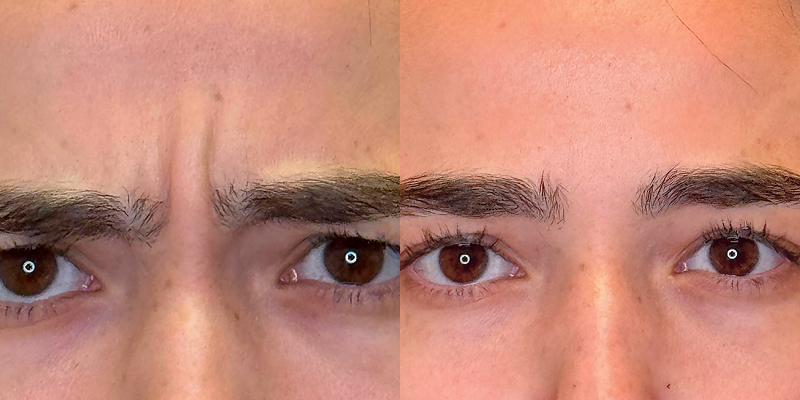
Neuromodulator Before & After
See the natural-looking improvement achieved with a customized neuromodulator treatment at MD Glow Lab Toronto.
Can neuromodulators be preventative?
Some patients seek treatment before lines become deeply visible at rest. Reducing repeated folding may slow the process by which a dynamic line becomes more established. Preventative treatment does not mean everyone should begin injections at a particular age.
The better question is whether your muscle movement is creating a concern that you want to manage. Facial anatomy, expression patterns, skin quality, and personal preference matter more than a birthday. A conservative plan can also be adjusted over time as your goals change.
When do results appear, and how long do they last?
Early changes commonly begin within three to five days. The full effect is generally assessed around ten to fourteen days after treatment. Results often last approximately three to four months, although duration varies with the product, dose, treatment area, muscle activity, and individual metabolism.
Maintenance timing should be based on how your movement returns and on your personal preferences—not simply on a fixed calendar date.
What is the treatment experience like?
Appointments usually take about 15 to 30 minutes. Small injection marks, bumps, or mild redness can occur and typically settle quickly. Most patients return to ordinary daily activities immediately, although you should follow the aftercare instructions provided at your visit.
Before treatment, tell your provider about previous injections, medications, health conditions, allergies, and any unexpected reaction you have experienced. Bring photographs of a previous result if they help illustrate what you liked or would prefer to change.
Afterward, avoid judging the result too early. Different areas and products can begin to change over several days, with the full effect commonly assessed around two weeks. That assessment point allows the treatment to settle before decisions are made about whether an adjustment is appropriate.
Neuromodulators versus dermal fillers
Neuromodulators and dermal fillers are both injectable treatments, but they address different contributors to facial aging.
Neuromodulators reduce selected muscle activity and are primarily used for movement-related lines. Fillers add or restore volume and may be used to support contours or address folds associated with volume loss. Treating a frown line and restoring cheek support, for example, involve different anatomy and different products.
Some patients benefit from one category, while others may have a phased plan involving both. More treatment is not automatically better; the plan should address the actual source of the concern.
Common questions worth discussing
Before proceeding, consider asking:
- Which muscles are creating the line or shape that concerns me?
- How much movement should remain after treatment?
- Why are you recommending this product for this area?
- When should I assess the final result?
- What changes would suggest I need a different dose next time?
- Would another treatment address part of my concern more directly?
How do I choose the right neuromodulator?
You do not need to arrive at your consultation having selected a brand. It is more useful to explain what bothers you, how much movement you want to retain, whether you have had previous treatments, and what you liked or disliked about those results.
Dr. Wong can then recommend Botox, Dysport, Xeomin, or an appropriate treatment strategy based on your anatomy and goals. Learn more about neuromodulators at MD Glow Lab or request a consultation to discuss your options.
Begin Your Glow Journey
Experience the art of science-driven beauty - refining your glow and elevating your confidence through natural results by Dr Keith Wong.
Have a question about which treatment is right for you? Send us an inquiry, or book your appointment online when you are ready.
